
The Ultimate Coach’s Race Guide: Ironman Wales (Tenby)
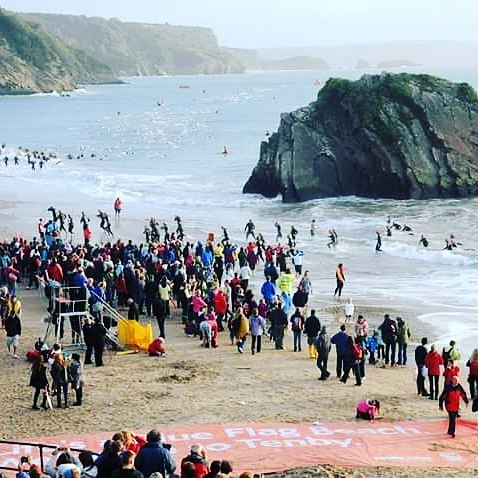
Ironman Wales is widely considered one of the toughest, most iconic full-distance triathlons on the global circuit. Between the legendary sea swim at North Beach, the relentless rolling Welsh hills, and an electric four-lap town run powered by thousands of roaring spectators, Tenby delivers an unforgettable day.
However, its extreme terrain and unpredictable coastal weather mean brute force alone will not get you across the finish line. To conquer Tenby, you need smart pacing, flawless mechanical execution, and a strict energy management strategy.
Here is the expanded, deeply detailed Ironman Wales (Tenby) Race Guide, rebuilt around the core philosophy of the Stealth Squad: “Train Your Weaknesses, Race to Your Strengths.”
Stealth Squad Edition: Mastering Execution through Strategy & Physiology
Ironman Wales is not a race where you can rely on raw fitness alone. Between the Atlantic swell at North Beach, over 2,500m of brutal Welsh climbing, and a relentlessly undulating four-lap marathon, Tenby punishes ego and rewards execution.
To conquer Tenby, you must apply the core Stealth Squad ethos: Build resilience in training by confronting your limiters, but execute on race day by staying strictly within your physiological strengths.
The Stealth Squad Philosophy: Applying the Principles to Tenby
- Train Your Weaknesses: In the 12–16 weeks leading up to Tenby, you must spend time uncomfortable—building heavy-gear torque capacity, practicing ocean sighting in choppy swell, and training your gut to absorb 80–90g of carbs/hour on steep inclines.
- Race To Your Strengths: On race day, you do not test your limits; you execute your plan. If climbing is a weakness, you gear down and protect your quads. If running is your strength, you hold back on the bike so your run engine actually gets a chance to ignite on Lap 3 of the marathon.
1. The Swim: North Beach, Tenby (3.8 km / 2.4 Miles)
Course Specs & Challenges
A two-lap, sea swim start with an Australian exit across soft sand. Water temperatures sit between 14°C and 16°C, often accompanied by ocean swell and chop.
Advanced Stealth Execution & Stroke Mechanics
- Train the Weakness (Pre-Race Build): Ocean turbulence breaks down long, gliding strokes. In training, build a robust 3/4 catch-up rhythm with a crisp, high-elbow Early Vertical Forearm (EVF). Practice high-tempo drills and CSS sets so your stroke rate stays punchy (60–70+ strokes/min) when fighting chop.
- Race the Strength (Race Day Execution):
- The Aussie Exit Spike: Running up soft sand causes a massive spike in heart rate and lactic acid. Do not race the exit. Trot easy across the beach, lower your respiratory rate with deep exhale-focused breathing, and enter lap two at a controlled Critical Swim Speed (CSS) pacing (+3 to +5 seconds/100m slower than flat pool pace).
- Sighting Strategy: Sight on top of the crest of the swell, not in the trough. Look for fixed high landmarks on shore (the Tenby cliffs or headland buildings) rather than floating buoys that disappear between waves.
- T1 Transition Run (1.0 km Hill Ascent): The climb from North Beach up the zig-zag ramp to T1 is legendary. Leave a dedicated pair of old running shoes in your T1 Pink Bag at the top of the ramp. Put them on—do not attempt a 1 km hill run barefoot over rough tarmac.
2. The Bike: Pembrokeshire Coast (180 km / 112 Miles)
Course Specs & Challenges
A two-lap, 180 km course accumulating 2,500m+ (8,200ft) of elevation gain. Features narrow country roads, dead-end road surfaces, sweeping headwinds, and iconic, crowd-lined ramps like Heartbreak Hill in Saundersfoot (up to 12% gradient).
Advanced Stealth Execution & Pacing Metrics
- Train the Weakness (Pre-Race Build):
- Low-Cadence Torque & VLamax Management: Tenby’s steep ramps force your cadence down. Build strength on the bike trainer with low-cadence torque blocks (50–60 RPM at Sweetspot/FTP) to condition your connective tissue without spiking your anaerobic capacity ($\text{VLamax}$).
- Gearing: You cannot “race your strengths” if you are under-geared. Run a 30T, 32T, or 34T rear cassette.
- Race the Strength (Race Day Execution):
- Cap Your Micro-Surges (NP vs. AP): The goal on Tenby’s bike section is to keep your Normalized Power (NP) as close to your Average Power (AP) as possible. Every time you push over 85–90% of your FTP on a steep climb, you burn precious glycogen that you will desperately need at mile 18 of the run.
- The 10% Rule on Hills: On steep ramps like Heartbreak Hill or Carew, spin a light, efficient cadence (75–85+ RPM). Let the crowds cheer, but keep your eyes locked on your power meter. Cap your hill efforts at 80–85% of FTP max.
- Aerobic Decoupling & Efficiency Factor (EF): On Lap 2, monitor your heart rate drift relative to power. If your heart rate spikes by more than 5% for the same watt output (Aerobic Decoupling), your body is under thermal stress or dehydrating. Back your target power off by 10–15 watts immediately.
3. The Run: Tenby Town & Countryside (42.2 km / 26.2 Miles)
Course Specs & Challenges
A 4-lap marathon winding through Tenby town and out towards New Hedges. Constantly climbing or descending—flat ground is almost non-existent.
Advanced Stealth Execution & Mechanics
- Train the Weakness (Pre-Race Build):
- Eccentric Muscle Loading: Descending hills at speed damages quad muscle fibers. Integrate downhill running drills and strength training (eccentric Bulgarian split squats, heavy step-downs) into your build phase to bulletproof your quads.
- Race the Strength (Race Day Execution):
- The Lap 1 Trap: Exiting T2 into Tenby town center feels like entering a stadium. The crowd noise will tempt you to run 20–30 seconds/km too fast. Control the adrenaline. Treat Lap 1 as a extended warm-up.
- Pose Running Gait on Inclines: When climbing the New Hedges hill, do not over-stride. Shorten your stride length, lean slightly forward from the ankles (not the waist), and maintain a quick, light foot strike targeting 88–92 SPM. Mid-foot landing directly beneath your center of mass reduces knee strain and quad fatigue.
- Downhill Pacing Strategy: Do not sprint down the descents! Let gravity pull you down while keeping a high cadence to absorb impact softly.
4. Precision Fueling & Metabolic Management
- Train the Gut: In training, practice taking in 80–90g of carbohydrates per hour on long ride-to-run brick sessions.
- Race Day Fueling Protocol:
- Bike: High-concentration carbohydrate drink mix + isotonic gels. Aim for 80–90g carbs/hr + 600–800mg sodium/hr (higher if hot/humid).
- Run: Transition to liquid gels and water at aid stations. Take onboard 60–70g carbs/hr. Walk the aid stations for 15 seconds to ensure fluid ingestion rather than spilling it down your chest.
Stealth Squad Race Execution Summary
| Section | Key Risk | Stealth Squad Winning Execution Strategy |
| Swim (3.8 km) | Cold water, chop, Aussie exit heart rate spike | High-elbow EVF stroke, easy trot across beach exit, sight at wave peaks. |
| Bike (180 km) | Pushing too hard on Lap 1 climbs, quad burnout | Strict cap on NP (<80% FTP on climbs), high-cadence spinning (32T/34T cassette), monitor Aerobic Decoupling. |
| Run (42.2 km) | Over-running Lap 1 in town, quad destruction on descents | Short stride/high cadence on uphill ramps, soft mid-foot landing downhill, walk aid stations. |
| Nutrition | GI distress, bonking at mile 18 of the run | 80–90g carbs/hr on bike, 600–800mg sodium/hr, practice gut absorption in training. |
Ready to Execute Your Best Race Yet?
Conquering a iconic course like Ironman Wales requires structured preparation, biomechanical efficiency, and bulletproof pacing data.
- 🏊♂️ Master Your Open Water & Sea Swim Mechanics: Join our 2-Hour Coastal Mastery Sea Swim Clinics or book a 1-to-1 Video Analysis with Speedy Swimming.
- 🚴♂️ Get Race-Specific Training Plans & 1:1 Coaching: Build your torque, dial in your power-duration curve, and conquer your target race with Stealth Endurance Coaching.
👉 Claim Your Exclusive 7-Day Free Trial to the Stealth Squad Here
 Stealth Endurance Coaching Squad